French Pocket Microscope (No. 114)
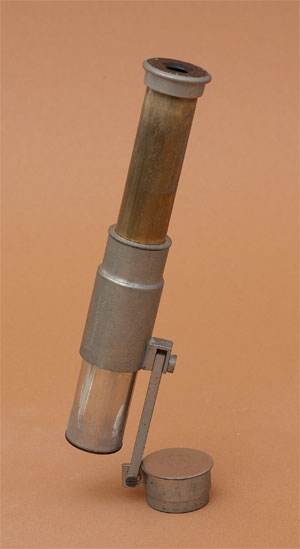
Made by: Manufacture d’armes de Saint Etienne
Made in: Saint Etienne, France
This instrument is a nickel-plated brass pocket microscope for observation of field collected objects. Included is an instructional pamphlet printed in French, English and German. This microscope has a simple cylindrical shape, and is small; certainly a pocket instrument. It was manufactured in France by Manufacture d’armes de Saint Etienne. The model shown here is their Model No. 1, with no support legs. Twenty five years later the company introduced Model No. 2. The earlier model sold for 6.40 francs. The improved model No. 2 sold for 68.50 francs. The microscope is a folding pocket microscope approximately 11cm long. It consists of a tube supported by a rectangular pillar connected to a cylindrical sample holder. The holder doubles as the objective cap when folded. The microscope body has an internal draw tube for “variable” magnification. The optics consist of a single achromatic objective and a two-lens eyepiece. On the base cap is engraved Microscope Universel Brevete S.G.D.G Agrosst-variable. The microscope can be setup to accommodate many different sample kinds, but all are remarkably unstable. Imaging is very good showing no chromatic aberration, but some vignetting. The magnification is approximately 10x.
